Monday, July 30, 2012

Well dang!  It's been a while!  I have upgraded into a more-than-full-time job and I've been focusing a lot on service, running  events and putting out fires and such.  Did you know that when you're awarded a Purple Fret that they expect you to keep doing more work? HA!  I knew there was a trick there somewhere.

But in all seriousness, I'm checking in before I leave for Pennsic tomorrow.  I miss thinking and writing about my medieval projects!  I am stepping away from running events this year (I did 12th Night in Ealdnordwuda and Squire's Tourney this past year) and focusing on ME!  My arts have gone by the wayside even though I have learned a few new things.

I've been gone from blogger so long that the format for posting has changed!  Good changes, very easy to use.  Very intuitive.  So here's a picture of one of the new things I learned: threaded-in split-pack tablet weaving...

The very beginnings of beginnings. I found this pattern extremely beautiful and easy at the same time--a rare find.
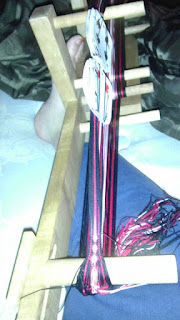

The pattern is based on an Anglo-Saxon find as described in this link

I'm really excited at the ease with which I picked this up.  I also finally understand how to do brocading on table weaving, but I don't have any examples yet.  Hopefully I can take a class at Pennsic this year to be able to show you.

I'll bring back lots of pictures since I'm going to try to take at least 1 class a day while I've there since I'm always working my Pennsics instead of enjoying them.  Don't get me wrong, the volunteering is great, but I need to feed my artsy fartsy side.


In Other News:

I helped last year in making a bunch of short-sleeved fighting undertunics suitable for breastfeeding and quick changes for the now Her Excellency Runa Kirri, but who was Pennsic War Queen last year for the Midrealm.  Enjoyed it immensely since I got to be a little creative in colors and finishes for our stoic little queen.  Can you imagine giving birth while crowned and having so many responsibilities and issues to deal with?  I mean, it's pretty historical in precedent, but our current middle ages seem somehow less forgiving than the originals.
I really can see a difference in my technique improvement from tunics I made several years ago to now.  My finishing is tighter and more precise, I finally forced myself to iron everything properly as I go along (it makes an incredible difference in finished look), and my hand sewing is even better.

The hand sewing has always been my stronger suit, which is lucky for medieval clothing since the fitting and cutting and construction are all aimed as hand construction rather than machine construction.  Godets and gores and gussets fit better if put together by hand, easing in sleeves and around curving fitting lines and darts are easier.  Shirring and pleating (especially cartridge pleating) are beautiful and look authentic and crisp.  Finishing a handsewn project is a great feeling too.  Those long, long hours of hard work and I always get more compliments on my hand sewn garb than on my slapdash pre-Pennsic rush gowns.

So in short, new classes being written for hand sewing techniques, will be trying to teach them as a series through the winter months at various events.  Teaching and sewing are coming back to the forefront for me!  Very exciting!

More pictures after Pennsic!

-Jorun

Monday, February 21, 2011

Good News Everyone!

Well, they bushwacked me again and hit me with a Purple Fret at Val Day two weekends ago.  I'm proud of myself, but still find myself a bit of a fraud.  I would not have recommended me for that award, but it seems I deserved it.  I really do just play this game to have fun and play dress-up and buy wool.  Any subsequent volunteering is really only a means to a wooly end...

My giant, red, wooly rear end trembling before Their Majesties as the herald reads my scroll out.
Photo by Dan Peacock


Anyway, I have a few other updates!  I finally found an incredible job that I love to death and that allows me to not only have time for sewing (ironically), but the drive to sew and the money to do it.  What I do is inconsequential, but I really am enjoying myself and enjoying being financially stable finally.

I'm delving deeper into the research and starting to ask the right questions of myself and my persona, I think.  I'm very much trying to narrow my kit to a specific time period and to basically create a living history kit to wear at specific living history functions.  I've actually been considering joining a living history group more specific than the SCA for this purpose, but there's nothing incredibly local right now and I've got a few years until I can afford that type of travel anyway.  I'd never leave the SCA, but I would like a more specific outlet for my research tendencies.

We're doing Golden Seamstress 10 as a low-key, no-stress, low-competition endeavor this year to build Jahanara her tourney garb to match Berach's to keep us in the game since we didn't compete last year and we want to compete intensely next year in Heian Japanese again.  I'm really rather excited as it her garb a really interesting mix of Norse and Levantine or Jerusalem Arabic.  I'd love to win our category, obviously, but we really just need the practice and team cohesion.  It's also our last year to get Emma on the team for a while so we're looking forward to that.

Last June, I posted an updated garb project list and I wanted to go back over it again and do another update!:
Garb Updates!:
  • The blue tunic is on hiatus until further notice.  I hate it more and more every time I look at it.
  • In the picture above, I'm wearing the red wool hand sewn gown.  It's really gorgeous and I get compliments on it constantly.  I took the first length of tablet weaving I ever made and used it as wrist and neckline trim.  I think it looks amazing.
  • The experimental hangerrock is sorta weird, but I like it.  I need to fortify the top edge with a backing of some sort either on the inside or trim on the outside so my brooches don't ruin it.
  • The brooches are great, but I'm now trying to find a substance that will allow me to hang my beads and things that won't break and scatter my beads like an em effer.  Tried silk, wool, linen, and now I've moved onto wire.  Next step is plastic-coated wire for modern beading.
  • I didn't make the Birka coat (but I have one in the planning), but I did change an old wool Middle Eastern Caftan into a Rus Kaftan, lol.  I'm currently reworking it once again to fit better and hand sew it instead of machine sew it, and to let the seams out so I can line it.
  • No Thorsbjerg trousers yet, but I'm still planning them.  I've got 4 pairs of braises that I'm sticking with and this spring, I'm buying more linen to make more.
  • Still haven't learned to spin or naalbind, but this Pennsic I should be able to buy my equipment and take some classes.
  • Still working on the extant find map/timeline thing.  There are so many that are in other languages that progress is slow.
  • The hand sewing class has 1 beginning part.  In teaching it a few times, I discovered that it really needs to be split into 2 classes for the very beginiest of beginners.
  • Tension on the tablet weaving continues to ellude me.  Will keep trying.
  • Loving the organization scheme and it's helping me finish things one at a time instead of trying to start 50 projects at once.
  • Garb repairs done, but garb upgrades continue as my skills improve.
  • Sorting Gold Key like a crazy person and accumulating more, much to my chagrin.
  • I'm playing with natural dyes now and I've found it incredibly interesting.  I posted a whole series to my Facebook page on tests this past summer.  Maybe I'll transfer that over here.
  • Am now bound and determined to purchase a custom or semi-custom sports bra for fighting.  The period alternatives will not work until I lose some weight and have less chest to heave around so that's on hold indefinitely.
  • I'm currently lacing my lamellar together and doing slow work in the Bellatrix style of fighting training.  Wish me luck in my newest endeavor.  I'm planning a tunic for wearing underneath and I'll post pictures of the progress on that once I'm beyond design stage.
  • I recently took on the MOAS position in the canton as well as the chatelaine.  I'm excited and really pepped to do 
  • I entered my first A&S display at Val Day.  I got lots of nice comments and it was really good practice writing the documentation.
So that's all my updates for now.  Look for new pictures and writing in the next few months.

Sunday, July 18, 2010

Did you know that we're eligible for a 10% discount at Joann's?

SCA, Inc. members are eligible to apply for a 10% in-store discount card at Joann Fabric and Craft Stores!

To apply, first make sure your membership in SCA, Inc is current. If you are a non-member SCAdian, you do not qualify. You must keep your membership current to maintain your discount card. You can maintain, update, or apply for SCA, Inc membership here.

Next, print off a copy of SCA, Inc's IRS 501(c) (3) tax exempt letter. You can find it here in .pdf form.

Next, fill out this form at joann.com. Be sure to click on the Non-Profit Discount Card button or your application will be rejected. "The Society for Creative Anachronism, Inc" will not fit in the Organization Name box. Use "Society for Creative Anachronism, Inc".

That's it!

Wait 4-6 weeks for your card to be mailed to you. When you recieve your card, take your printed copy of the tax exempt letter to your closest Joann store and have them activate your card before purchase. You must have the letter and a state-issued ID. You will also need to bring your SCA, Inc blue or white membership card as well.

Have fun!

-Jorun

Friday, July 16, 2010

"Thinking About Female Images in Viking Art" by Cathy Raymond

Cathy's blog is here.

This is the post I'm reading and pondering right now.

Just a few thoughts on aprons

So here's something to think about. In the post comments, a poster writes that the Anglo Saxons and Franks weren't known to wear aprons (at least in any extant finds or contemporary artwork). However, in Viking Age Norse art there are quite a few images that suggest (in a very stylized way) the presence of aprons.

Another commenter on the post points out that Venetian courtesans wore aprons as a disguise to blend in with the local goodwives, but that it eventually became symbolic of their status.

Follow me in this musing

Most modern people think of the apron as simply a utilitarian item (and an increasingly uncommon one, or one associated with pre-feminist Western life). An apron is virtually unnecessary in a world where modern people dress in very accessible, affordable, easily washable fabrics and have access to washing machines and dryers that remove 90% of the work of laundering.

Your shirt got dirty? Throw it in the wash.
Your shirt got stained and you can't get it out? Send it to Goodwill or throw it away and buy another.

However, in a world where your clothing has to travel from the back of a sheep to a spindle to a loom to a needle to get to your body, you want to protect the precious fabric that it took you a year or more to make if you include the husbandry of the sheep.

That's where an apron comes in. A linen apron makes a lot of sense to me, even if the linen or flax had to be imported to the more northerly Scandinavian regions. Linen is much easier to wash, bleach, and replace. Linen has a nearly as intense process from ground to cloth as wool, but the fiber itself is easier to care for once it's made and it doesn't depend on a food source to grow.

Linen, unfortunately, does not last as long as wool when buried with a decomposing body. Very few examples of linen are found in the extant record for the Viking Age. Cathy Raymond suggests that they could have just decomposed before the find was dug up. This seems a likely possibility.

So why would Norse women/goddesses be depicted wearing aprons?

I've got to go back to symbolism.

We already know from the record in the Sagas and some of the written laws that women had a much more equal and vocal footing in a marriage and in society than their Christian contemporaries and their eventual progeny as Christianity spread into the far corners of Europe.

So what if the pagan Norse symbolized womanhood or wifery with the apron as the symbol? The female head of the household would be ultimately in charge of many, many important responsibilities on a landholding, many of them messy and guaranteed to ruin a fine wool gown.

Any good pagan worth her salt will wish her representations of her goddesses to reflect the world she lives in. A responsible wife needs an apron to run her household and maintain her wardrobe, well why wouldn't a goddess? Thus we see the images of goddesses women in art as wearing aprons.

It's possible, then, that the Anglo Saxons and Franks, used aprons but never attached any symbolic meaning to them and so never represented them in their art.

Like the Venetian courtesans, aprons from utility to symbolism.

-Jorun


Saturday, July 10, 2010

Theories of cultural transmission before the Silk Road between Europe & Asia may pan out?

Before the Silk Road cultures!?!

I happened across the "Trollen Braid" controversy on the Norsefolk Yahoo! list and was intrigued, so I did a little Google digging. I'll state beforehand that this isn't conclusive research (or even very professional at that) and to please not be spreading this around as fact.

However, you could use it to warn people away from claiming that Trollen Braiding Wheels, as they're now being called in the reenacting world, are period. They are probably not within the SCA period, and most of the information regarding the wheels themselves is a garbled, internets version of the "Telephone" game.


The files that intrigued me initially:

http://groups.yahoo.com/group/Norsefolk_2/files/Clothing%20and%20Textiles/Brenna/
If you can't see them, just sign up for the list. It's a really good hardcore medievalist list with very prominent members from the academic world and reenacting world. It's not SCA-exclusive, however, and they try to stay away from solely SCA-related discussion since not everybody is a SCAdian.

There is also a huge discussion in the archives regarding these files, so check that out too.


Googling:

I Googled and came up with this:
http://www.kelticos.org/forum/viewtopic.php?f=18&p=7632
This blog post that led to the abstract below.

http://textilesociety.org/abstracts_2002/Barber.htm
Abstract. If anyone knows where I can read the actual paper, please let me know.


Googling on the "Trollen"braid again:

The Trollen Braid:

http://www.robinsonhistorical.co.uk/images/Work%20Sheets/Braided%20Cord.pdf
A how-to, showing a marudai-like weaving board and similar techniques


However! (And there's always a however)

http://etimage.com/english/bearingdial/bearingdial.html
This site states that the wheels claimed by reenactors to be for weaving were probably for sea navigation. Personally, I'm apt to agree with them since one was found in Greenland (very difficult to navigate to, according to The Far Traveler: Voyages of a Viking Woman by Nancy Marie Brown), and they are not broken in half as reenactors have assumed.

Also, "Tools for Textile Production from Birka and Hedeby. Birka Studies 8" by Eva Andersson (the premier source for textile artifacts in that region for the Iron and Viking Ages), makes no mention of these wheels. I'm also apt to side with the expert, especially since one of the wheels was found at Haithabu (Hedeby).

And, the big name herself, Else Ostergard of the Danish National Museum, has said through (hearsay) conversation with a European reenactor [http://www.et-tu.com/soper/cgi-bin/index.cgi?action=forum&board=open&op=display&num=105&start=30] that the disk was found in Trelleborg, Sweden rather than Trelleborg, Denmark (Trollen) and is probably 17th century in extraction. This hints that it is a post-our-era tool find as well as probably culturally transmitted from Japan or China along the silk road or through overseas trade routes rather than in earlier eras through casual contact and eventual cultural dissemination in the Eurasian deserts.


But that leaves out the braids themselves!

It could be some form of whipcording (what is often called Viking Battle Braiding or slyngyng similar in our community, also not very documentable in an extant tool sense, though the braid structures are, apparently, but I digress).
http://www.northernneedle.net/Research/whipcord.pdf

However, the much more practical and sedate method of fingerloop braiding is the more probable culprit.

http://www.stringpage.com/braid/fl/fingerloop.html
This site cites a book on Japanese fingerloop braiding and that brings it all back full circle!

The way the above page is written is some reason to suspect (so that I don't get caught in an endless loop of trailing down sources of everything, I'll just propose it and stop there), that fingerloop braiding is documentable to the Medieval period in Europe, and not the earlier Iron or Viking Ages--Pre-Silk Road.


To sum up my thoughts on the tl;dr:

Since it's possible to create the structures of these braids in several ways (from top down on kumihimo marudai and the so-called Trollen disks to bottom up with whipcording and fingerloop braiding) it's reasonable to make a preliminary case, as without publishing or claiming authenticity, that the artistic and practical uses for these braids were known to cultures in Europe and Asia through their contacts in the Pre-Silk Road era. It doesn't necessarily mean that this was the transmission method--it could be that these things developed naturally in fiber cultures.

-Jorun

Saturday, June 19, 2010

Where the heck have I been?

Well, I'll tell you I've been incredibly busy and life has been happening and etc, etc.

Besides having a writing habit that goes in spurts, I've been trying to cope with the Michigan economy and the very nonexistent job prospects here. So, I started my own business as a seamstress doing alterations and making soft goods, costumes, and clothing for commission clients. That line of occupation is slowly chugging along.

The more exciting news is that I've been doing a lot of sewing and research for this SCA habit. I've been mainlining wool for about 6 months now.

I'll back up a little. I finally found a culture that I'm comfortable in for my SCAdian game and I'm considerably more committed to the research for Norse culture. It's been a long road for me, bouncing from a newcomer to 14th century English to 12th century Anglo-Saxon, to dabbling in Safavid Persian and Ottoman Turkish, to finally 10th century Hiberno-Norse. I feel like I've landed at home and I've not looked back. There is the rather difficult aspect of changing my name now that most people know me as Gillian, but it's been a transition and I feel like it's starting to work.

So my new fascination in Norse culture has led me to a very specific interest in using the proper materials for my garb. There's less wiggle room in Norse culture for fudging with silk and linen to save money, so I've been searching high and low for deals on wool. Luckily, it's been a wool-heavy modern season or four and I've built up enough of a stock to start fortifying my kit with real wool. In my heart, I want to be spinning and weaving my own wool for clothing, but modern woven will have to do for now.

To this aim, I've been trying to learn as much as possible about textiles and am starting to dip into textile production. I've also been sinking further into tablet weaving as that's what Norse women do when they aren't spinning and weaving and sewing and cooking. It's a busy life being a Norse woman!

Garb Updates!:
  • The blue tunic in the previous post is still not finished because I ran out of stupid DMC floss in that color and I've been too distracted to go find more. I also have no documentation for the embroidery style and I made the seams before I knew how to properly flat-fell seams. It will languish until I have more energy for it.
  • I'm nearly finished with my first hand-sewn wool kyrtle (gown/dress/whatever) and will find the time to post pictures when I have it fitted properly. I also need to do a little fulling on the seams to prevent unraveling and to lock the wool together to seal the seams. It's still lacking a hem and a neckline finishing--is anyone surprised?
  • I'm preliminarily finished with a experimental hangerrock in a style I think is possible based on the Birka finds. It's made from basket-woven, multicolored hounds-tooth wool.
  • I finally have a pair of brooches to hang my wealth from and hold up my hangerrock. Purchased from Raymond's Quiet press and based on a find from Yorkshire, UK.
  • I'm in the planning stages of a Birka coat and a cloak based on the Valkyrie images.
  • I now have enough serviceable underwear to stop having to wear modern pants and shorts under my garb. I based the first ones I've made on braises, but the next stop will be Thorsberg trousers.
  • I'm planning on finding someone *cough*NYM*cough* to teach me to spin and also someone to teach me to naalbind. For this, I'll need spindle, whorl, maybe a distaff, and a bone needle. It's time for me to make Norse stockings instead of using the 12th century hosen.
  • I'm putting together a map and time-line of the major archaeological finds that include textiles for the Viking Age. Probably to be submitted as an A&S project at some point. I have never seen anything like this, so I'm hoping it will be well-received.
  • I'm developing a 4 part series of classes dedicated to hand sewing and focusing on Viking Age stitches and techniques. The first part is finished and I attempted to teach it at Squire's, but no one showed up to the class. Still debating on whether or not I want to teach it at Pennsic next year in the full 4 parts. I'd like to teach it a few times just to see how it goes first.
  • I just finished my first real tablet woven project. It's pretty rough-looking. Tablet weaving is definitely an acquired skill, but I'll keep chugging at it.
  • I sorted and arranged all my garb stash fabric, decided what I would use it for, and labeled it all. This was part of a huge organizational project for my office. I also hung up all my garb and arranged my upstairs spare bedroom into a garb and SCA stuff storage room.
  • I made all the repairs on all the garb that needed it.
  • I sorted out all the garb I don't need anymore and added it to the Ealdnordwuda Gold Key that is now in my possession. I also sorted all the Gold Key by type of garment and labeled the boxes so it's easier to find people garb they can wear.
  • Last summer, I did a huge RIT dye project and dyed some of my older, yuckier garb more acceptable colors. I'm so much happier with it now. The two unbleached chemises I made for my very first Pennsic in 2005 are still in use as camp scrub garb and now they're dark red and salmon pink. They've been reworked since that Pennsic (thank goodness) and are now just very light t-tunics with short sleeves.
  • Still halfheartedly searching for a period alternative to a bra that will give me support and not make my chest look like a swamp monster. I fiddled for several years with a princess-cut thing, but it mashed my boobs up funny. I'm back to modern bras for the sheer saving of my neck and back, but the search continues slowly. I think some sort of fabric wrap will be the next attempt, but then I'll need aid in getting dressed. I especially need something to go under my armour so I can comfortably swing a sword. Budgetary concerns and this bra issue keep the armour front stalled as well.


Friday, March 6, 2009

New Tunic

So I'm making a linen tunic. Basic, t-tunic with embroidery on the seams and on the cuffs and hems.

Here are some pictures of the yet-to-be-completed project.


I really want a dress form. The next big sewing purchase I make will be a freaking professional dress form. There's no life to a garment without it.


Saturday, January 24, 2009

Interesting developments

So I'm thinking of taking a huge step.

I want to make and sell some garb. On Etsy.


Not a lot. Just a few pieces. Test the waters, if you like.

I find there's a dearth of reproduction/recreation/accurate-in-any-sense-of-the-word clothing for the SCA or even for LARPers and Rennies. I want to develop a few basic cotes, kirtles, hoods, and body linens with the basic Nockert types found at this site. I'm trying to get my hands on the Nockert articles and books, but they are proving illusive to my ILL.

Carlson's site is definitely one of my favorite sites as far as collected information on basic medieval clothing that most medieval hobbyists wear. Very organized, very professional. I'm trying to find a way to do this without stepping on Marc Carlson's copyright.


I made a version of this gown last year for Val Day. I added sleeves to the undergown and left the original as a surcote. It's based on the gown of St. Clare of Assisi. There's not much information the Carlson's page about this particular gown, but the extant examples of some of the Herjolfnes kirtles and cotes are more in-depth and worth a look.

Obviously, making my own personal version of the gown is fine because I'm not selling it (plus I added an extra gore accidentally, thus changing the gore count of the gown). Making it up as-is and selling it may be on the sueable side of wrong. Even if it's not, I still feel uncomfortable selling something I haven't personally researched and thought through.

At the very least, I can use the Nockert types as proto-patterns to create a few gowns for myself and refine my own style (as I'm convinced most everyday medieval people did) to fit my body or the body of my customers.

This is assuming I will have any. Anyways, I need my gowns to use for pictures on the site so I can provide examples for buyers so they can order their own custom garment. I don't want to hold any stock and I'd like to be able to personalize each garment. I think it's important to have nice garb even if you can't sew.

I'm also using Etsy because they unofficially encourage barter as a form of payment, but also offer PayPal as a payment mode. For example, I really need someone who can do tablet weaving for me. My patience with it is very limited. I want more historical trims for these garments, or at least someone who I can send my customers to if they are interested in historical trims.

I can't tell you how tired I am of seeing crappy, unhistorical garments labeled as "SCA", "medieval", "renaissance", or any combination of the three on eBay and Etsy. It's a damn shame that so few options are required. Metallic and polyester trims make my eyes bleed. I want to give people a choice. Right now all they have is a choice between junk and more junk. I really hope I can influence the SCA community (at least, if not a wider audience) to go more authentic.


More work is going into this and you'll hear more from me to this end. Oh, and I was planning on offering versions done with a machine and versions done by hand, just so people would a have a choice. Also offering very simple embroidery around the interesting edges or the seams...or anywhere I guess...for extra, of course. And offering them in wool, linen or silk. I think that covers a lot of bases.

YiS,
Gillian


Picture from:
Carlson, I. Marc. Some Clothing of the Middle Ages Historical Clothing from Archaeological Finds. Last date edited. 1996-. Text html and digital images. Marc Carlson. Available: http://www.personal.utulsa.edu/~marc-carlson/cloth/bockhome.html. 24 January 2009

Monday, August 18, 2008

*Lady* Gillian de Chelseye

At Midrealm's Pennsic court, I was awarded my Award of Arms (AoA) and can now call myself either Lady Gillian de Chelseye, or Gillian de Chelseye, AoA.

My friends conspired to make a proper lady of me and I certainly was surprised. I nearly fell off my bench and had to be escorted to the dais by my clan brother Berach.

Lady Maeve Dianotto inscribed my scroll, and a view of her magnificent work can be seen here at her website.

I also was awarded a baronial Northern Star for Service during the baronial Pennsic court.

In other news, this lady is finishing her armour and will begin fight practice next week Wednesday.

Woot!


YiS,
Gillian


Tuesday, June 24, 2008

Much to my surprise...a t-tunic!

Well, I thought I had several more hours of work to go on Anne's t-tunic. Surprise, surprise, it's done in under 2 hours and just needs hemming and the collar finished. And that's hand work anyway. I might use a contrasting seam binding for the collar. Pretty it up.

So, here it is, just in time for Pennsic. (And that means I can cut the second kirtle tomorrow at work). The color is a little hard to discern from these pictures, but it's a sort of jade/grey green. Great little dyeing mistake that turned out well. I guess it could look teal in the right light, but it seems like jade green to me.


For you Authenticity Buffs out there, here's what I usually base this pattern on:

http://www.personal.utulsa.edu/~Marc-Carlson/cloth/type5.html


15th century kirtle

I finished Anne's first kirtle today at work. The last thing I have to do is cover the grommet holes with embroidery floss. Normally I would hand-bind the eyelets, but this is the quick and dirty way. It'll look nice with the floss over it though. And she'll have to find something to lace it with (lucet cording works well), because all I have is a safety pin to hold it together at this point.

The major seams are machine sewn, but the sleeves, the hems, and the collar are all hand-finished. It's helpful to have nothing to do at work and plenty of sewing to do. It makes me want to work even harder so I can get through my garb to-do list before Pennsic.

In period, they would have worn this over a long sleeved-smock, then pinned on lower sleeves to cover the smock arms. Here's a period painting illustrating such:


and...


So without further ado, here's some pictures. Hopefully I get some with her in it at Pennsic.


Thursday, June 12, 2008

News and Notes

Well, it's a good thing I haven't had much SCA news to post lately, as I've had plenty of mundane accidents and emergencies to deal with. The most exciting (and problematic) of those was the tree that fell on my house. Needless to say this put a speedbump in my roadway to Pennsic projects.

Speaking of Pennsic projects and fast approaching deadlines related to said projects, I've made another list!

My personal garb

  • wool peplos/bog dress for official MacEoghain functions
  • wool Persian coat for our "A Meal in the Levant" class
  • dark blue linen tunic dress, 13th century
  • chevron weave tan linen short sleeve tunic dress, 13th-14th century
  • at least 3 more Bohemian Bathouse smocks, 1 linen and 2 muslin
  • an early 15th C. kirtle, linen
  • an 11th C. tunic dress in lightest peach with a surcote in rosy lavender
  • at least 3 more pairs of hose
  • real garters, instead of fabric scraps (or more fabric scraps...)
  • wool inserts for my period shoes
  • at least 2 pairs of drawstring pants
  • 5 pairs of shorts/underwear (the last batch were cut wrong, wrong, wrong and I refuse to wear bike shorts again this year because they're too hot)
  • 2 new veils, linen
  • a new coif, linen
  • a dark grey wool court dress, 13th century with embroidery
  • 2 cotton tunic dresses, 12th century
  • alterations on blue cotton tunic dress
  • a Viking/Rus ensemble, tube dress over-tunic
My projects for other people:

  • 3 gowns; a 11th C. tunic dress and two 15th C. kirtles for Anne, Io's new lady. It's her first Pennsic and her first garb and hopefully she'll be comfortable. Possibly a few Bohemian Bathouse smocks, but I'm waiting for the go-ahead on those.

Sure, it's a lot of stuff, but I'm mostly finished with one of Anne's 15th C. Kirtles, and I have the tunic dress cut out. Once her stuff is done, I can finish mine. I'd like to be able to take an actual amount of clothing this year so I'm not running around in my chemise.

More later, maybe some pictures.

Wednesday, April 23, 2008

A little off-topic, but I found this fascinating

From Ms. Frizzle's blog:

Aoccdrnig to rscheearch at an Elingsh uinervtisy, it deosn't mttaer
in waht oredr the ltteers in a wrod are, the olny iprmoetnt tihng is
taht the frist and lsat ltteer are in the rghit pclae. The rset can
be a toatl mses and you can sitll raed it wouthit a porbelm. Tihs is
bcuseae we do not raed ervey lteter by it slef but the wrod as a
wlohe and the biran fguiers it out aynawy.

Friday, March 28, 2008

Someday tent project


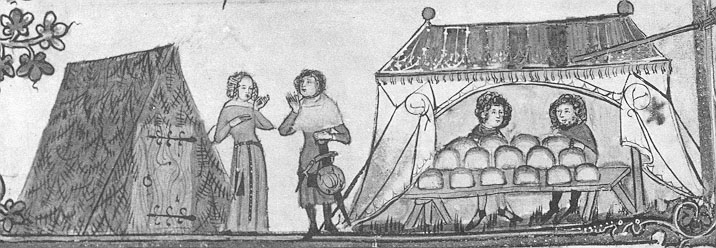
I want to build the tent with the pine branches and the wooden door on it in this picture from the Romance of Alexander (Bodley 264), c. 1338-44.

*sigh* So many projects, so little time.

I've been working really sporadically, but still furiously on my Flemish kit. More updates on my Flemish blog.

Yours in Service to The Dream,
Gillian
(Gille? Gill? Giles? <--That's my name when I'm in armour.)

Thursday, March 6, 2008

Tablet weave garters

So I'm currently dabbling in tablet weaving and I think I'm making garters for my hosen. I'd also like to make another pair of hosen with the wool scraps from my new wool. The garters will be dark blue, teal-ish blue, and orange wool/silk.

I've been using cotton scraps for garters up to now. I'm just having a problem sitting down and finishing my tablet weaving. It makes my back hurt. Maybe I can entice Gwenyth to finish it for me...I'll have to ask her next week. I can make her one of the new bags. More about those later.

YiStTD,

Gillian

P.S. I took down the Flemish garb posts and moved them to a new blog of their own: http://flemishgarb.blogspot.com.

YiStTD,

Gillian


Wednesday, March 5, 2008

Research is so much easier with the internet.

I'm pretty sure that my generation will never pick up a book from the library again unless they go for Master's degrees or PhD's. I love the ease of the internet, the ability to cut and paste and bring multiple sources together in seconds. I feel like the people who went to college just ten years ago were left out of this information access. Internet research will dominate the academic world forever.

I'm so glad I can sit at home, watch the History Channel and research my Flemish gown from sources, paintings, and anecdotal recreations from all over the world.

What a great life for academics.

YiStTD,
Gillian


Tuesday, March 4, 2008

13th-14th century drawstring pouches with stamped designs

Ever since I checked out that textile book last summer, I've had it in my head to create a stamped fabric creation of some sort.

After much mulling over and hopeful thinking and studying of shapes and designs, I've finally decided to do some test samples. At first they will be very simple: a Fleur-de-li and a three-cornered Celtic knot. But I hope to move onto some of the garland and flowery prints as I develop. I'm hoping Corwyna will help me create wood blocks for printing eventually. For now I'm going to make very simple closed-cell foam versions.

There's about a million and a half ways to make these bags, so I thought a broad view of as much information as I can get a hold of was important. This site about pouches and bags and reliquaries, Oh my! has excellent links to pictures and information of different styles of bag.

This bag is the shape that I'd like to create. The silhouette, if you will:


"woven of silk and wool with the arms of Brabant-Limbourg and Bourbon, 1291-1310"
Picture Source
Caption Source


I'd like to have tassels attached like in this picture:


1300-1330
Picture Source (This is my screen capture of detail. You can find the full picture at this site.)


And this is sort of what I'd like to eventually accomplish as far as print styles go:


"Small bag or aumônière made in Italy in the 14th century; fabric is apparently a form of brocade made of silk, linen, and cotton"
Picture Source
Caption Source

So that's it for now. See you tomorrow.

YiStTD,

Gillian


A good answer to someone's question on SCA-Garb Yahoo Group

This question was asked by a new fighter's mother on SCA-Garb Yahoo Group that I belong to. I was impressed with my answer--that sounds self-involved, doesn't it? Anyway, I thought it was a good solution to her problem, so read on.

I'm not sure where else to ask this question.

My son is now an authorized fighter, as of last weekend. Of course, nothing will do but that he LOOK splendid. Problem is, I know JUST what I want, and have no idea where to find a pattern to use or adapt for what I want. Maybe ya'll can help me.

I've seen fighters in surcoats with "cap sleeves" and split "skirts". The coats usually have ties in front or back.

Am I making sense? And can anyone here point me in the right direction to find a pattern for this? I could probably "wing it"....but this is for my son, and it has to be JUST right. (nooooooo....*I* am not a veryproudMommy)

Fiondel

Mother of Arthur Gordon, newest Calontir fighter


Congrats to your son, Fiondel. I hope to be taking that journey later
this summer. As a new fighter (and a girl who loves to sew), I too
want to look good and avoid the barrel plastic/carpet look. I've been
at the books with this problem for a few months and this is what I've
found.

I might know what you mean by cap sleeves, but split skirts are a must
for any fighting tunic that falls below the hips any distance for the
sheer need for mobility.

That said, there are literally thousands of ways to make a fighting
over-tunic and even more ways to decorate it.


Three things to consider when choosing a style:

1.) Is it mobile enough for my fighting style? (This is VERY
important! A fighting tunic designed for speed and agility in a
tournament differs greatly from one for giant melee wars like at
Pennsic where heat and exhaustion become important factors.)

2.) Do I want to research and provide authentication for my style, or
do I just want something that fits and looks good and damn the A&S
exhibit? (The latter is a very valid choice, especially if you're low
on funds/skills/time)

3.) How much money, time, and skill do I have and what can I do with
them? (Cotton bedsheets in a rainbow of colors can be had from
second-hand stores for a few dollars. Please, PLEASE use all-natural
fabrics (not wool though--too hot--although there may be some who
disagree with me) for fighting garb of any sort because polyester will
hold heat close to the body and can cause a myriad of heat-related
health issues. Sewing machines can be found there as well or retail
for as low as $70 dollars and as high as $7000. Will you need help
drafting a pattern or draping and pinning? How will you finish the
seams? Decorate with appliqués or embroidery?)


********
Now onto your suggested style of tied tunic with cap sleeves:

I would wing it if your son is set on that look.

Before you do that, though, talk to some fighters wearing that style
and pump them for information:

Is it documentable and what is that documentation? (again, if this
matters to you, if not, then ignore this question. If you do ask it,
pick a good time--not right before the fight and not right after.
Give them a few minutes to warm-up/cool down.)

How does it wear in the heat? Is it easy to clean? What kind of
fabric? How long did it take to construct? Ask any questions you
feel necessary and make sure to write down the answers. Maybe even
get contact information so if you have another question, you can email
them. It's a good way to make new friends and a great way to learn a
little bit about various cultural differences in the SCA.

IF you cannot find anyone to talk to about the style, I would sit down
and sketch and fiddle with what the style will look like--even if you
cannot draw. Many period styles are based on geometric shapes and are
easy to draft out on graph paper.

This is what I *think* you are looking for from your description:


Body front and back:


Sewn at shoulders and has open armpits, "cap sleeves" attached along
the top of armscye and not all the way around.

Attaches around body by ties at the bottom of the armscye and at the
hip, but you can add more if necessary.

The sides below the hip are open to the hem for mobility.

You can shorten or lengthen the hem as needed.

Reinforce the neck scye, the armscyes, and the ties because they will
get a lot of wear and tear. Plan on replacing the ties periodically,
and maybe after the first battle--a small hand sewing kit throw into
the armour bag should be a part of his armour repair kit anyway.


Sleeve:


Covers only spaulders/pauldrons and ties underneath arm.

Make sure you measure the spaulders so that they completely cover them
and do not impede the movement.

Make the ties long enough and reinforce them at the sewn points. I
would cut them from strong fabric on the bias, or use 1" bias tape
sewn closed.

Do not use poly or cotton "rope" trim from the fabric store for the
ties. At first chance it will unravel or break and it's a pain in the
butt to sew securely onto cotton/linen/anything. If you *must* use
it, get a smaller gauge (less than 1/2") and hand sew it on so you can
be sure it's on tight.

(EDIT 2/4/08: thinking about this more in depth, using tablet or inkle-woven bands, lucet cording, or finger loop braids would be very period depending on what era you're involved in. They look cooler too. The tablet weaving doesn't have to be intricate, a simple one-color band would do as well as anything fancy and you won't be as devastated when it rips.)

***************************************

So I think I just solved my own problem with surcote sleeves. It makes me happy. I like this a lot. Not to mention that a plainer version will allow my Clan tabard to stick out better in a crowd. However, while these plans are for "to the elbow" sleeves, I think I'll be making mine long enough to cover my yucky ugly plastic wrist bracers.

YiStTD,
Gillian


Monday, March 3, 2008

Persona Identity Crisis

So I know I'm not the only one who changes or wants to change or has changed their persona, but I'm in a real pickle here. I've got eighteen thousand projects in various stages of development currently and they all seem to be from different eras and places. It really puts me in a bind as to who Gillian wants to be within the Society and what Melissa wants to spend her mundane time doing.

I've always had the goal in the SCA to avoid MPD--Multiple-Persona Disorder--because I think it's tacky if done wrong. But I also like being able to blend in with my surroundings and having a multitude of options. I have this sort of obsession for the accurate and documentable. It's not enough for me to know how things were done, I have to achieve it too. I guess it will help to list and describe the projects that are pulling me in these many directions.

Let's go in order of importance:

1.) Rework "Beyond the Wench: Mid-16th Century Garb on a Budget" to fit a 30 minute class time by the end of April, including my own sample researched Flemish outfit from the skin-out, including headgear with a budget of $30. I only have the research, drafting, and chemise finished (and the chemise isn't truly finished--HEMS!).

2.) Finish gambeson, surcote, chausses, braises, and other non-garb elements for my fighting kit.

3.) Finish test samples for toddler garb for eBay. I need the cash and I need to free up the space that my less historic fabrics take up for my new nest of delightfully expensive new textiles.

4.) Use some of the new wool flannel to make a winter peplos so I can play as a Celt sometimes.

5.) Use the new silk to make a simple 13th C. Persian-inspired garb for ME-themed events.

6.) Use new linen for making another 13th century gown, surcote, and ruffled fillet/barbette for summer courts.

7.) Use new wool and linen to make Viking dress and apron (and coif), respectively.

8.) Use new wool for making another 13th c. gown for winter courts.

9.) Make fabric stamps for sample 14th c. drawstring fabric pouches. That would preclude me actually making the sample bags as well.

10.) Make some simple Byzantine garb with research and extant examples/paintings/other art because I feel like it isn't well-represented in this area (or in the Midrealm for that matter).

11.) Repair and finish all garb in my wardrobe. This include hems, cuffs, and neck scyes.

12.) Organize sewing materials and notions and give them their very own area in the apartment, with a distinct sewing table. Go through fabric collection. Put aside fabrics for the Canton newbie garb event next Fall. Consolidate scrap bags. Sort fabrics by type into separate tubs. Sell fabrics with value, but are of no use to me. Use older/yuckier fabrics in my collection to make Pennsic junk garb that I can destroy without feeling guilty.

13.) Die of overwork and take 10-day vacation at Pennsic with all my garb finished AT LEAST 3 weeks beforehand. (HA!, yeah right.)


I'll stop there because it's my lucky number, ironically. Legend has it that Friday the 13th is considered unlucky because the Knights Templar were attacked en masse and destroyed on Friday, October 13, 1307 by King Phillip the Fair of France. There is no documented date of the incident though, so don't listen to what History Channel tells you as it is often very, very wrong.


YiStTD,
Gillian


Wednesday, February 20, 2008

Yes, I know I just posted, BUT...

I wanted to gush about my toddler interpretations of period clothes. I'm not a mom, but I am an aunt. I spend countless hours with the girls (14 m/o twins!) and have always wanted to make them some garb just to see what period construction can do for ease of wear in kid's clothes. I've often thought modern clothes far too "cookie" cutter and unable to adapt to the wide range of shapes and sizes in kids and adults.

On eBay, at least, it's very hard to find simple, sturdy children's SCA garb that doesn't look like bargain bin junk. It is *especially* difficult to find garb that is cut to allow for expansion--which I suspect would have been a period practice, though I don't have hard proof. It's also hard to find children's garb that looks fairly authentic.

So I measured Boo Boo and Moo Moo (identities concealed with my nicknames for them) last week to see what I could mock up. I did three separate patterns from one mock of the same cut.

First of all, I worked on a girls t-tunic that was layerable and with extra seam allowance to let out (or take in) as they grow out and up. They currently wear 18 m/o and 24 m/o commercial clothing. I added an extra 3 3/4 inches to the hem, 4 inches to each front and back panel horizontally so that almost 8 inches can be taken out around the chest and waist. The hem will fall just below the knees.

Next, I made a simple coat that could pass through Byzantium to the Levant to the Mongolian steppes. I'm leaving everything plain so the new owner can add what he/she likes for the period they prefer. I left out the gores, but I cut them and am including them when I send them in case someone wants to add them in.

Lastly, I made a really simple peplos for the little female Celts/Romans/Greeks out there. When I decide on a male pattern for trousers and leg wraps that will fit diapers, I'll market them with the t-tunics for the Celt/Viking boys.

For the future of the line:

I also made a simple coif pattern based on my own. It's 16th century based (3 piece), but I'm going to do a pre-16th C. 2 piece pattern for the real authenticists (like me) out there. I'd also like to do a liripipe hood and a hood-less cape. I'm also a little bit interested in a simple middle class Flemish from the Tudor era.

I'm definitely investigating making basic muslin chemises in two styles: square neck with finished wrist cuffs for the later period, and regular round neck with open wrists for the earlier period tunics and peplos.

Any more ideas, leave them in the comments!


So hopefully, I'll have about 8 samples for sale (and pictures for an update here) on eBay by this weekend. I offer special free pickup for SCAdians who are attending the same events as me, so take a look and let me know if you're in the area and I can deliver at the event.

Yours in Service to The Dream,
Gillian